Two things go on your floor.
One sensor. One receiver. Nothing else.
The sensor goes on the bearing housing and does the measuring. The receiver goes on a wall and carries the readings off the site. No new cable is run, and nothing is wired into your controls.
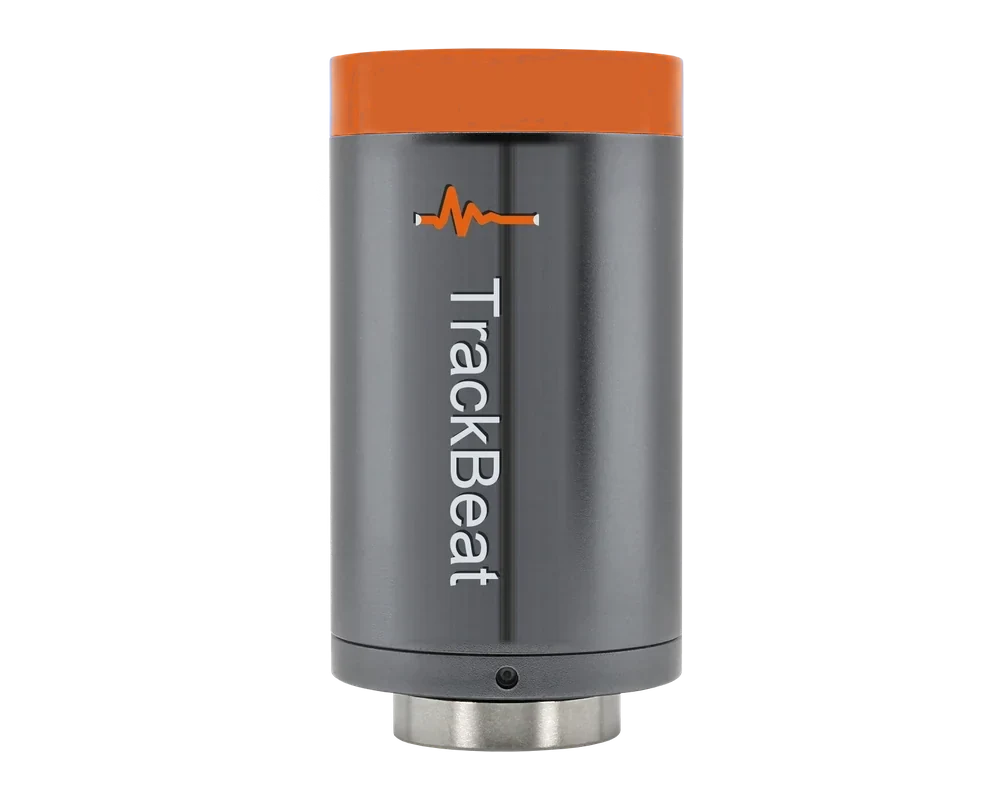
Drag to spin

Drag to spin
How the two work together
Four steps, from the bearing housing to a named fault.
- 01The sensor measures
A burst every 15, 30, 60, or 120 minutes: vibration on three axes, temperature, and shaft speed. You set the cadence to how fast that machine can surprise you.
- 02It does the math on board
The bearing frequencies, velocity RMS, and FFT band energies are extracted in the sensor. The radio carries a small feature packet, and 48 hours of raw waveform stay on the device for a second look.
- 03The receiver relays
Readings arrive over licence-free sub-GHz radio, 902–928 MHz. The receiver passes them on through one outbound connection, MQTT with TLS, over Wi-Fi, Ethernet or LTE.
- 04The platform names the fault
The receiver is a relay and does not diagnose. The platform compares each reading with the ISO 20816 zones and that machine's own baseline, then names the fault.
What it asks of your plant.
Very little. The hardware is fitted from the outside of the machine and the outside of your network, so production and IT both keep what they have.
- No line shutdown
- The sensor mounts on the outside of the bearing housing, by magnet or stud, in under a minute, on a running machine.
- No wiring, no controls work
- Nothing connects to a PLC or a historian. The battery-powered sensors need no power run to them.
- No new network for the sensors
- Sub-GHz radio reaches the far end of the plant without new cable or access points.
- No inbound firewall rule
- The receiver opens one outbound connection. Nothing is opened inbound.
- One to three receivers
- That is what a typical plant uses. They are placed at scoping, not one per machine.
- Built for the floor
- The sensor is sealed to IP65 / IP67 for washdown and coolant spray. Battery life is 5–6 years, and each sensor reports its own state of charge.