Technical specifications
The numbers, not the adjectives. Published so a reliability engineer can size a deployment without a sales call. Anything not listed here is something we will not claim until it is measured.
Vibration + temperature sensor (TB-S01)
TrackBeat sensor family · One gateway, many sensors. Vibration + temperature, temperature and machine uptime today; Wi-Fi versions, hour meter and tilt next.
Coming next: Vibration + Temperature, Wi-Fi (TB-S02) · Temperature, Wi-Fi (TB-S04) · Temperature, AC-powered (TB-S05/06) · Hour Meter (TB-S07/08) · Tilt / Inclination (TB-S11/12)
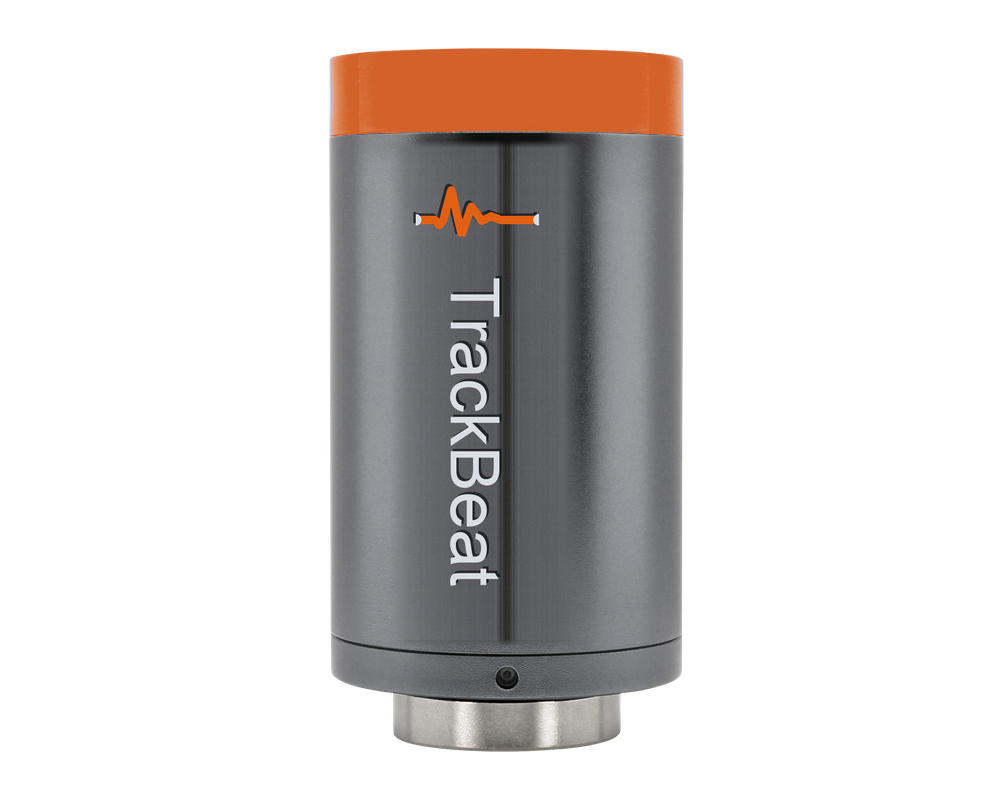
- Sensing
- Triaxial vibration, temperature and magnetometer in one sealed unit
- Accelerometer
- Wide-band triaxial MEMS, high-bandwidth
- Capture
- Burst every 15 / 30 / 60 / 120 min. Set the cadence to match how fast that machine can surprise you.
- On-device buffer
- 48 h of raw waveform, pulled on demand
- Radio
- Licence-free sub-GHz (902–928 MHz ISM) or Wi-Fi, per model
- Power
- Battery or AC, per model
- Battery life
- 5–6 years on the battery-powered sensors.
- Sealing
- IP65 / IP67. Survives washdown and coolant spray.
- Mounting
- Magnetic or stud, external. Fitted in under a minute, on a running machine.
- Output
- FFT band energies at BPFO/BPFI/BSF/FTF, velocity RMS, shaft speed
UpTime / DownTime sensor (TB-S15)
Running or stopped, one record a minute, from the machine itself. The sensor only measures; running and stopped are decided in the platform. Full page: UpTime / DownTime.
- Sensing
- Magnetometer and accelerometer. One reading every 5 s, twelve averaged into one record per minute: magnetic AC amplitude (0.1 mG steps) and vibration RMS (0.1 mg steps).
- Decision
- Running / stopped in the platform, per-machine thresholds, rule either / both / magnetic / vibration, blip filter in minutes. Changing a threshold re-evaluates all history.
- Report interval
- 1, 5, 15 (default) or 25 min, set from the console. One radio frame per report, up to 26 minutes in a frame.
- On-sensor log
- 2 MB flash as a rolling ring, about 288 days of minutes. Every minute is written before it is sent; the receiver fetches any minute still held.
- Receiver off
- After 3 unanswered reports the sensor sends once per interval, then backs off to at most 60 min apart (5–120 min, set from the console). Logging never stops; off-hours are back-filled.
- Radio
- Sub-GHz 902–928 MHz ISM, encrypted, same network as the vibration sensors. Data rate 10 / 110 / 250 kb/s. Listens 2 s after each report and in an awake window of up to 45 s.
- Power
- Replaceable lithium thionyl chloride D cell. Estimated life about 10 years with the receiver off 16 h a day. Reported as voltage; the cell has no useful percentage.
- Timekeeping
- No clock on the sensor. Minutes are counted on a 32 kHz crystal, about ±2 s a day, and stamped to wall time by the receiver. Counts carry on across reboots and battery changes.
- Magnet actions
- Touch: send unsent minutes now, LED confirms on acknowledgement. Hold 30 s: radio returns to the factory profile for re-commissioning; rejoins the network by itself after 30 min if nobody does.
- Mounting
- Magnetic, external, on the motor or machine housing. No wiring into the machine. First report one minute after power-up.
Gateway (TB-G01)
One gateway for every sensor in the family. It collects the sensors and opens one outbound connection.
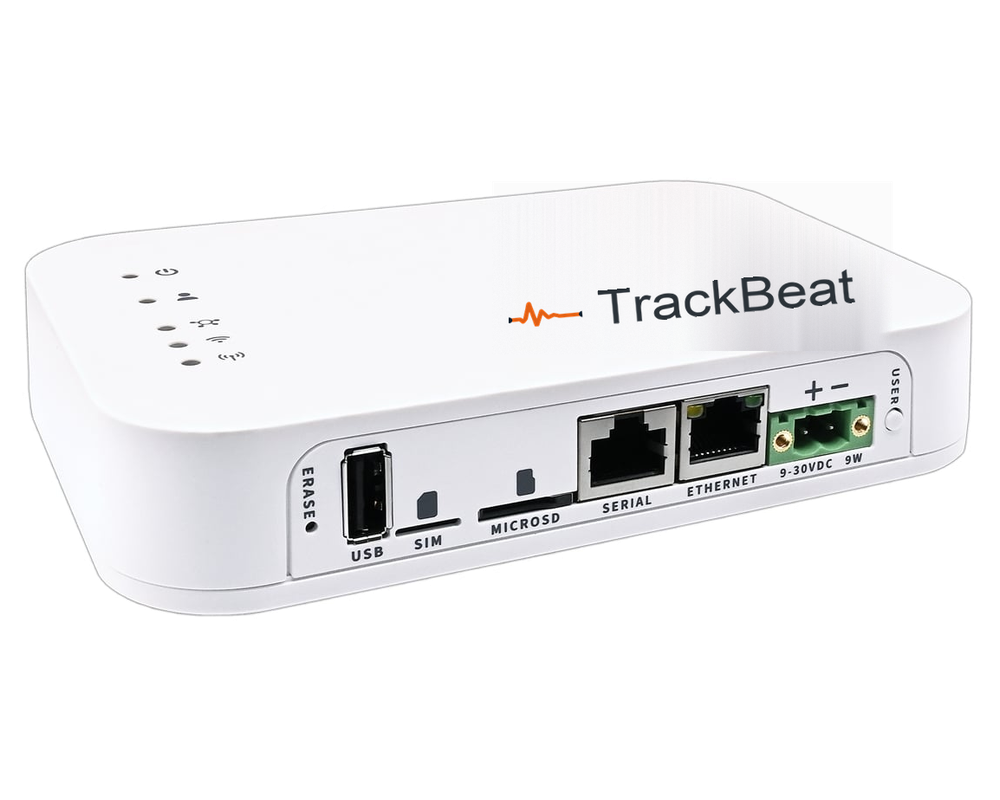
- Uplink
- Wi-Fi, Ethernet or LTE, outbound only
- Transport
- MQTT with TLS from the receiver. The product API is HTTPS.
- Local dashboard
- Runs on the device. The floor keeps its screens when the internet drops.
- Sensor link
- Sub-GHz. Reaches the far end of the plant without new cable or access points.
- Per site
- 1–3 units
- Hardware
- Digi XBee Hive Gateway with the XBee XR 900 radio, model XH-900-TW1-101. 900 MHz ISM, 902–928 MHz.
- Uplink hardware
- 10/100 Ethernet, dual-band Wi-Fi 5, LTE Cat 1 with a SIM slot
- Power
- 9–30 V DC, 1.75 W idle, 9 W peak. Mains adapter supplied.
- Operating temperature
- −30 to 60 °C. Indoor ABS enclosure, 148 × 99 × 33 mm, 0.24 kg.
- Hardware approvals
- FCC Part 15 Subpart B, ICES-003, CE, IEC 62368-1