Vibration + Temperature Sensor

The sensor that goes on the bearing housing. It samples vibration on three axes, temperature, and shaft speed, does the feature extraction on board, and keeps the raw waveform for 48 hours.
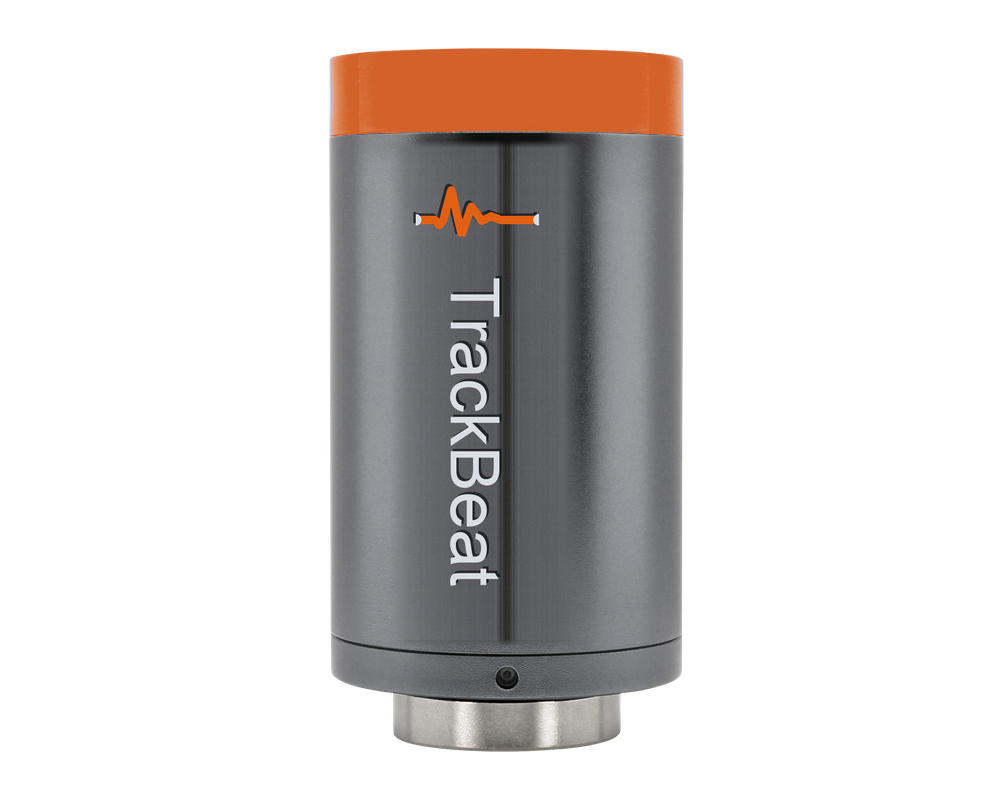
TrackBeat wireless vibration sensor, a sealed cylinder with a knurled battery cap and a stainless magnetic base.

Three senses, one puck

Triaxial vibration, temperature, and a magnetometer for shaft speed. A diagnosis has more than one channel to stand on.

The math stays on the sensor

FFT band energies, velocity RMS, and the bearing frequencies are extracted in the puck. The radio carries a small feature packet, not a continuous waveform.

The waveform is still there

48 hours of raw waveform stay on the device and can be pulled when a reading needs a second look.

One machine reads them all.

Every reading, shown here. The numbers are its own.
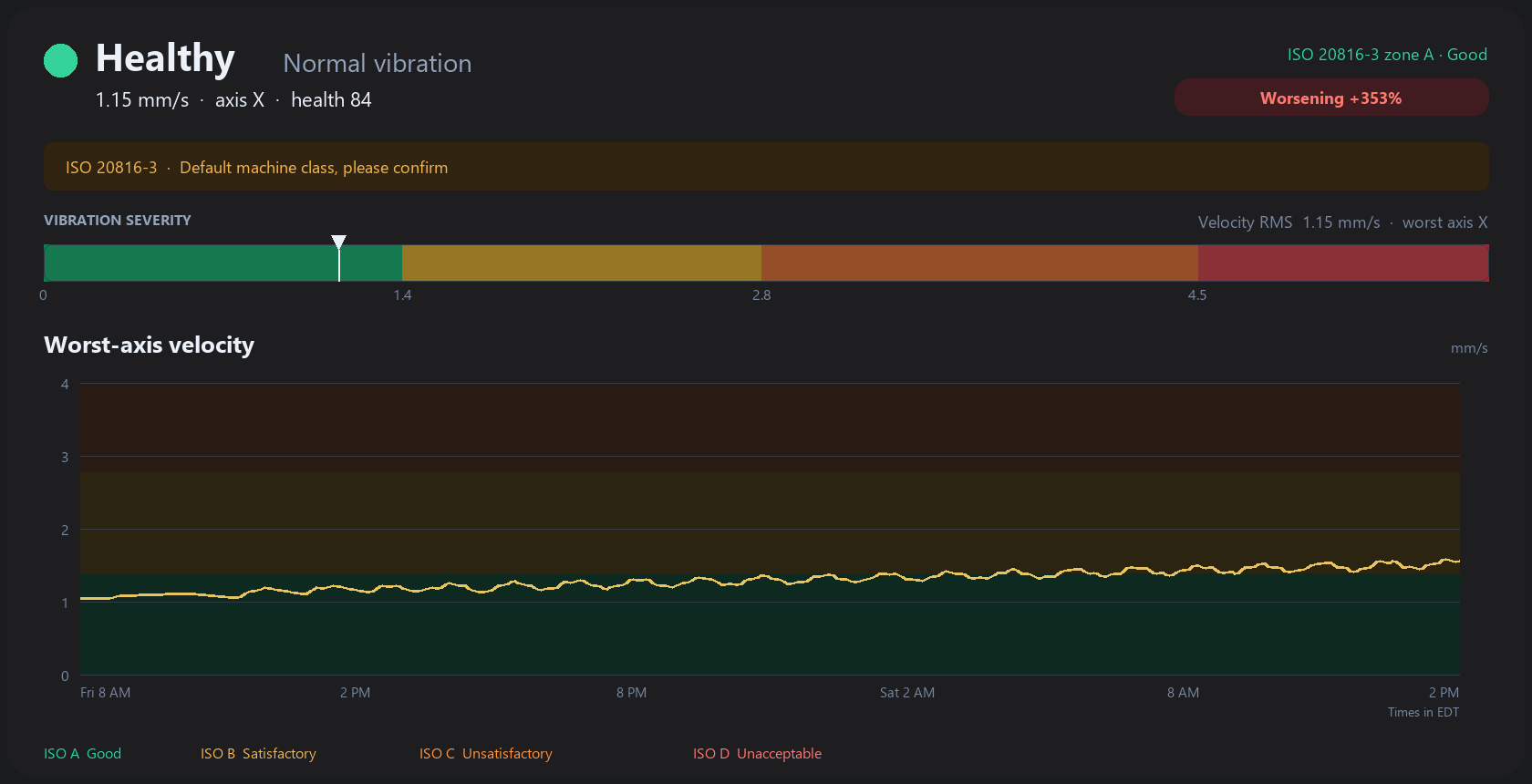
Compressor marked healthy, health 84, velocity 1.15 mm/s on axis X in ISO 20816-3 zone A, with the vibration severity bar and a 24-hour worst-axis velocity chart.
Overview · ISO zone and worst-axis velocity
Live cards for the compressor: shaft speed, temperature, anomaly, Mahalanobis distance, baseline, velocity RMS, acceleration RMS, peak, crest factor and kurtosis, then the spectrum peaks.
Overview · speed, temperature, and the spectrum peaks
Spectrum peaks for X, Y and Z, with drive-end and non-drive-end bearing frequencies and the sensor on the compressor.
Spectrum peaks · bearings · the sensor on the point
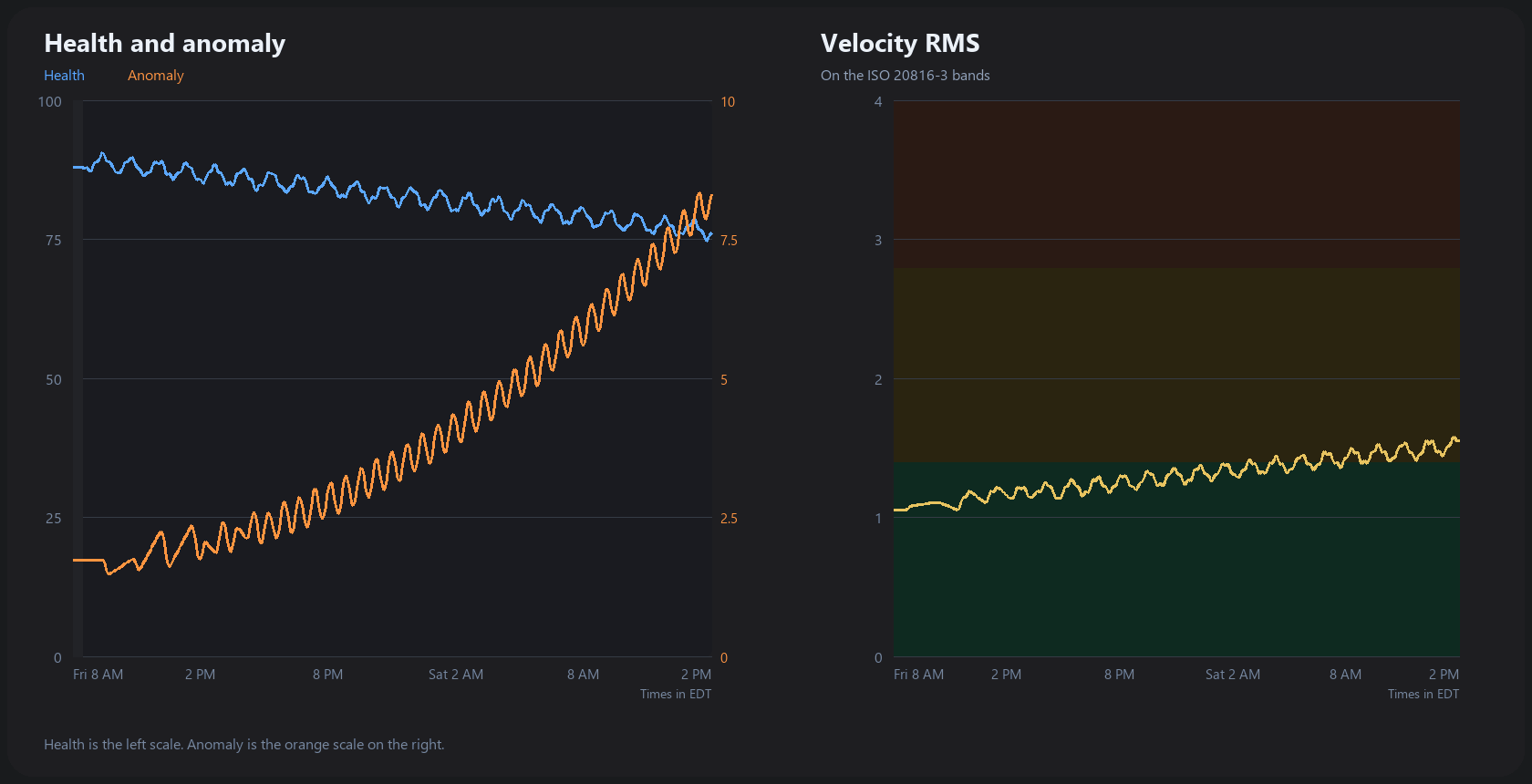
Health score and anomaly score charts for the compressor over the last day.
Overview · health and anomaly score
Health and anomaly together, and velocity RMS plotted on the ISO 20816-3 bands.
Trends · health, anomaly, and velocity RMS
Temperature, acceleration RMS, and per-axis kurtosis, with a watch line at 4.
Trends · temperature, acceleration, kurtosis
Per-axis breakdown for the latest reading: velocity, acceleration RMS, acceleration peak and crest factor on X, Y and Z.
Trends · per-axis breakdown
Latest readings, a few seconds old, for the compressor drive end: time taken, velocity, health, ISO zone, alarm, speed and temperature.
Raw data · the last readings

How it goes on a machine

Four moves. The machine stays running.

  1. Mount it outside Magnetic or stud, on the bearing housing. The machine stays running. No line shutdown, no wiring into the controls.
  2. It learns the cadence A burst every 15, 30, 60, or 120 minutes. Set that to how fast the machine can surprise you.
  3. It talks to the receiver Licence-free sub-GHz, 902–928 MHz. The receiver is the only box that opens a path off the site.
  4. The platform names the fault Bearing frequencies, imbalance, misalignment, looseness, and the rest of the coverage list. Two modes we do not claim yet stay marked as gaps.

Specifications

Figures not on this list are not claimed. The specifications page is the sheet a reliability engineer can size from.

3 sensesVibration, temperature, and a magnetometer
48 hRaw waveform stays on the sensor
IP65 / IP67Sealed housing
902–928MHz, sub-GHz to the receiver
What it sends
BPFO, BPFI, BSF, FTF band energy, velocity RMS, shaft speed
Capture
Burst every 15 / 30 / 60 / 120 min
Accelerometer
Wide-band triaxial MEMS
Power
Battery. It reports its own state of charge.
Mounting
Magnetic or stud, external
Part
TB-S01